
THE LAB · DATA DESK
Learn Python by solving cases
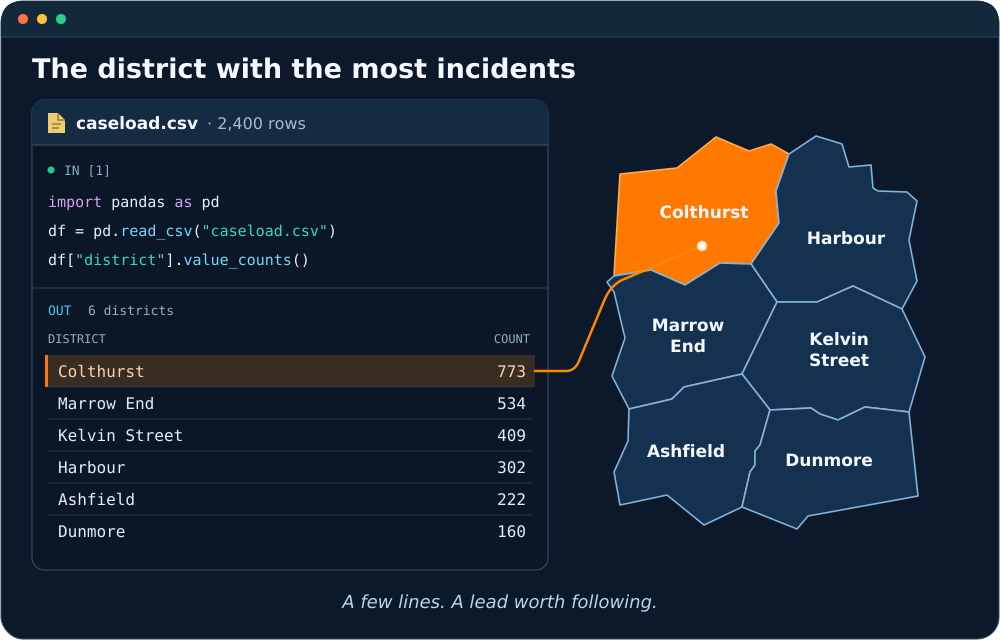
A real course behind the story: real Python running in your browser, from your first line of code to pandas, statistics, machine learning and automation.
Python, taught as casework
Real Python, nothing to install
Every line you run is real Python, with real pandas, SciPy and scikit-learn, running in your own browser. No setup, no environment to break, no screenshots of someone else's code.
See a move before you use it
Every case opens with a warm-up that runs an example one line at a time and shows what each name holds. Then the case asks for the move, on its own evidence.
The data is the evidence
A padded invoice, a clocked car, a lost wallet handed back empty. A case only closes when your own code produces the answer, so the finding is yours.
104 cases. 26 drills. 13 exams.
One free start, four specialisms.
Foundations is free and takes you from your first line to reading a file. Then pick a specialism. Each has three ranks, and every rank ends in a graduation exam: pass it and the rank is yours, with a certificate to share.
Values, lists, if and loops, dictionaries, your own functions and reading files, ending on your first look at pandas.
Data analysis in Python, for the data too big or too messy for a spreadsheet.
- RANK 1Forensic Analystread_csv, selecting and filtering, sorting, value_counts, new columns and .loc.
- RANK 2Senior Forensic Analystgroupby and agg, merge and concat, and two years of data set side by side.
- RANK 3Chief Forensic AnalystCleaning: gaps, text, types, duplicates and dates, then pivot tables and a pipeline over many files.
Prove a pattern is real and not a coincidence, and never charge the wrong suspect.
- RANK 1AssessorMedians, spread and z-scores, samples, the bootstrap and the standard error.
- RANK 2Expert WitnessShuffle tests, t-tests, intervals, crosstabs and how big a trial needs to be.
- RANK 3Chief Expert WitnessCorrelation, regression lines, and the hidden variables that fake a finding.
Check every file, page and listing by code, and catch what nobody had time to.
- RANK 1OperatorFiles and folders, logs, and reading and writing Excel workbooks with openpyxl.
- RANK 2Senior OperatorFormatted reports, charts, templates and emails, all written by code.
- RANK 3Chief OperatorWeb APIs with requests, paging, logging, and scraping only where it is allowed.
Teach a model from past cases, test it honestly, and find the fraud nobody flagged.
- RANK 1Trainee ProfilerFeatures and labels, your first model, a fair test split and the baseline to beat.
- RANK 2ProfilerRegression and its error, probabilities and thresholds, cross-validation and boosting.
- RANK 3Chief ProfilerEncoding, leakage, permutation importance, and a full pipeline scoring new cases.
Practise the round, not just the course
30 company-style problems from analyst, data science, engineering and ML loops: pandas, core Python, engineering, statistics and machine learning.
Run your code and see what it makes straight away, then meet the tests: edge cases, hidden datasets, and, where speed matters, a scale test that catches the slow answer, and 7 of them are free to practise.
 Weeks at Number OneSpotify · Easy · pandas
top = charts[charts["position"] == 1]
result = (top.groupby("track").size()
    .reset_index(name="weeks")
    .sort_values(["weeks", "track"], ascending=[False, True]))
A notebook, no case file
Sometimes you just want the notebook. The sandbox is the same Python the cases run, opened flat on 7 ready-made datasets, with 8 libraries on the shelf and charts drawn under the cell.
A blank notebook, one CSV of your own and 2 of the datasets are free. Your files never leave your browser: there is nothing to upload to us.
- pandasTables: read, filter, group and joinimport pandas as pd
- NumPyArrays and fast mathsimport numpy as np
- MatplotlibCharts, drawn under the cellimport matplotlib.pyplot as plt
- SciPyStatistical tests and distributionsfrom scipy import stats
- statsmodelsRegression, with the full summary tableimport statsmodels.formula.api as smf
- scikit-learnMachine learning modelsfrom sklearn.linear_model import LinearRegression
- openpyxlExcel workbooksfrom openpyxl import Workbook
- Beautiful SoupReading HTMLfrom bs4 import BeautifulSoup
What people ask before they start.
Whether it is a game or a course, whether you need to install anything, and which specialism to pick.
STILL WONDERING?
The first case answers most of it.
It is free and takes a few minutes. Anything it does not answer, ask us at hello@querycase.com.
Yes, and a full course at the same time. You work cases as a detective, and every case is solved by writing real Python against real data: a padded invoice, a clocked car, a lost wallet handed back empty. The difference from a coding puzzle is that it keeps going, from your first line of code through four specialisms, each with three ranks and an exam at the end of every rank.
No. Python runs in your browser tab, with pandas, NumPy, SciPy, statsmodels, scikit-learn, Matplotlib, openpyxl and Beautiful Soup ready on the shelf. There is no environment to set up, no package to install and nothing to break, which is where a lot of people give up before they write a line.
Yes. It is the standard Python interpreter compiled to run in the browser, so the code you write is ordinary Python and ordinary pandas. It runs unchanged in Jupyter, VS Code or a script on your own machine, and the errors you meet are Python's own, explained in plain English underneath.
Yes. Foundations assumes you have never written code. Every case opens with a warm-up that runs an example one line at a time and shows what each name holds, so you see a move working before you are asked to use it, and each case adds one idea at a time.
Foundations covers values, lists, if and loops, dictionaries, your own functions and reading files, and ends on a first look at pandas. Then four specialisms. pandas: filtering, groupby, merges, cleaning, dates and pivot tables. Statistics: sampling, the bootstrap, shuffle tests and t-tests, intervals, regression and confounders. Automation: files, Excel workbooks, reports and emails, and web APIs. Machine learning: features and labels, fair test splits and baselines, thresholds, cross-validation, leakage and pipelines.
Yes, in three ways. The pandas specialism teaches it case by case across three ranks, on datasets big enough that looking at them by eye stops being an option. The sandbox opens a notebook on ready-made datasets, or on a CSV of your own, with no case attached. And the Python interview room has pandas problems in the style real analyst interviews use.
Any of them: every specialism needs only Foundations, so you can follow whatever your job needs. If you are not sure, pandas is the usual first choice, since it is the tool the other three lean on. Statistics suits anyone who has to defend a finding, Automation anyone drowning in spreadsheets and reports, and Machine Learning is the biggest step, best taken last.
Foundations is free and stays free: 10 cases, 2 drills and the Lab Assistant exam with its certificate, plus the Python sandbox with two datasets and one CSV of your own, and sample interview questions. Pro is a single payment (14.99 pounds in the UK) that unlocks all four specialisms, every dataset, and the other QueryCase courses with them. It is not a subscription.
Yes. The Python interview room has company-style problems from analyst, data science, engineering and machine learning interviews, written and run in the browser. Your code is checked by tests, including hidden datasets and, where speed matters, a scale test that catches a correct but slow answer, which is exactly what a technical screen looks for.
Foundations is about an hour of cases, plus its drills and exam. Each specialism is roughly four to five hours of cases, plus drills, briefings and three rank exams. Cases are short by design, usually under fifteen minutes, so the course fits around work rather than in place of it.
STILL WONDERING?
The first case answers most of it.
It is free and takes a few minutes. Anything it does not answer, ask us at hello@querycase.com.